You are currently browsing the tag archive for the ‘Making Embedded Systems’ tag.
Tag Archive
Want to be on my podcast?
June 5, 2013 in Uncategorized | Tags: lists, Making Embedded Systems, podcast | Leave a comment
I have a podcast now: you can listen at http://embedded.fm/ or search for Making Embedded Systems on iTunes (or Instacast or Stitcher). The podcast is about embedded systems and, like this blog, it consists of whatever I’m excited about (and who I con into being my co-host/guest).
But what I really wanted to put here was some of the process stuff I’ve learned having done the first four podcasts. Here is the short version.
- Find guest, agree upon general topic.
- Make outline (ideally Wednesday before show)
- Send outline to guest, get mods back by Friday.
- On Saturday (or Sunday), do 2 hour recording session.
- Producer does producer-y thigngs
- Show comes out on following Wednesday.
So, once I hook a victim and choose a topic (i.e. “What an electrical engineer things a software engineer should know”), I make an outline.
The outline isn’t exactly a script, though the intro and outtro are written out. The outline is more a list of points and questions so I don’t forget any of my plans. We don’t have to stick to the outline but it means I don’t have the “err, what was it I meant to ask” feeling all the time. It also lets the guest know what things I’m likely to want to ask about so they don’t get caught off guard.
I sent the outline to the guest. Actually, the outline starts with a notes section:
I tend to script the first few minutes as it helps get comfortable. I have no problem going off script, it is just a crutch for the first few awkward minutes.
If you want this (or something else), let me know. We found paper to be noisy so I’d prefer to put your notes on my ipad if you’re ok with that.
Finally, I put in two end points. The goal is 45 minutes but I’d rather be 5 short than 20 long.
Next in the outline is the intro, all scripted out, as promised above.
This is Elecia White, welcome to Making Embedded Systems, the show for people who love gadgets.
This week I’ll be speaking with Phil King one of my favorite electrical engineers. The plan is to hear what a hardware guy thinks software engineers should know.
Hi Phil, welcome to the show.
[Phil says hello]
I know you’ve worked at some neat places, we made children’s toys for Leapfrog and a gunshot location systems at ShotSpotter. What else have you been up to?
[Phil gives 30s bio]
When I was a manager, hiring new embedded software engineers as my minions, Phil was part of the interviewing team. He was excellent at finding people with really good skills, even better, he could articulate what he liked (and didn’t like) about candidates.
So, Phil, what was your secret question?
And now we are out of scripting and into the outline. From here, there are lots of points I might want made (either by my guest or by me, I don’t usually differentiate). Sometimes these are question (“You always really cared, making sure we hired good software engineers. Why is that important to you?”) and sometimes they are just notes for both of us (“software engineers can damage to HW…”). Also in the outline, I might have reminders purely for me (“tell story about capacitors”) so I don’t forget something I think is nifty.
But these are just conversation points, if we skip one, no big deal. If the conversation is flowing, I’d like it to flow naturally.
Finally in the outline, there is the outtro, what I need to record when the show is over.
We’re out of time though I know we’ve got a lot more to talk about, you willing to come back?
[Phil]
Ok, thank you for joining me. Thanks also to our producer Christopher White and to everybody tuning in. Please leave us comments and questions at embedded.fm or show@makingembeddedsystems.com. We love to hear from you.
Next week, we’ll be talking to (? about ?). Have a good one.
I write the outtro so I don’t forget to thank people or say where to send comments.
Once the outline is done and sent, I start taking notes for random things I might want to say… extra things inside the outline bounds. Sometimes I ask for questions or information from twitter for “voices from the audience” sorts of things. I also try to think up some pre-show chat while we are getting the sound levels right (I jokingly asked Phil about his feelings on exclamation points, we got off on a tangent about the interrobang which made it into the show a little). It calms the guest (and me) and makes the show flow better if we are already chatting.
Recording isn’t hard, thanks to my husband-producer-superhero, Christopher White. He’s done wonders to make us sound good. Despite most people not liking their voice (me included!), everyone has been happy with the recordings, so far. In addition to monitoring sound levels, he tags points where we start and stop (hey, I stutter, sometimes I don’t want to share that) and highlights where we mentioned things that should go in the show notes (that RSS feed doesn’t write itself, you know).
Recording takes about 1-2 hours to get enough info for around 45 minutes of show. Later, usually right before he releases it, Chris edits the audio to eliminate the goofs. He makes us sound good (and balanced), does any bleeping, adds music as needed (he wrote the intro!). He attaches it to the RSS feed, presses publish. That makes it go to iTunes and Instacast and Stitcher where people can get it.
If you want to be on the show, please let me know. Most of my guests haven’t done too much prep (I want to talk about what you know, not something you need to learn and prepare for) so the process is about 2.5 hours of your time: gadgets, embedded systems, parts, technology, working on gadgets, maker projects, etc.)
There are some things I still need to figure out. We have a recorder I can carry about (if I’m willing to get crummier audio) so it is possible to do on-site things. But I need to learn to use it better, especially to get voices right for an interview. I have a plan to interview someone in San Francisco in July so I have a deadline. And I know some people do podcasting via Skype audio which would increases my pool of guests; I want to sort that out.
There’s always more to try out and to learn. And I suppose when there isn’t, I’ll do something else.
Embedded systems conference call for abstracts
October 13, 2012 in Uncategorized | Tags: Making Embedded Systems, tech | Comments closed
About a year ago, I was getting ready to push the giant, red button that said GO for my Making Embedded Systems book. I thought that once I was done writing, it would be finished. Then I thought once the figures and tech reviews were done, the book would be ready to go. Surely once we fixed all of my misplaced commas, it was done, right?
Not really. Then I started doing promotion. I did two webinars for O’Reilly. Those are a lot of work. I also looked around for other promotion to do: speaking at schools, talking to magazines about reviewing my book, being in the scary “out there” to meet people and market my book.
I also wanted to present at the embedded systems conference in the spring, I’d attended for many years but here was my opportunity to speak! By the time the GO button was pressed and I came up for air, I’d missed the conference deadlines. There was a slot for someone to talk about LEDs but what do I know about LEDs?
Turns out, enough to fake it. With the wonderful help from EE Rob Mitchell, I did a live demo on how to take some Christmas lights and make them run from an Arduino (similar to Deep Darc’s blog post). I showed how I could make lights to leave up all year as they changed colors based on day of the year. We went from boxed lights and uninstalled software to working things, showing the process of cutting wires and loading software. We even talked about productization paths, methods for getting from idea to market and how to look at costs.
We had more show than information but it was fun. And live demos are tricky things; the audience is there to see you succeed. But if you crash, burn, and light a fire on stage, well, that’s ok too.
Even though we were in the LED section of the conference, we got all-access badges which let us go to any session we wanted. And we got access to the break room. It doesn’t sound like much, but it was where all the other speakers hung out. And there was lunch, coffee, assorted snacks, tables, and chairs. At times, it felt like heaven.
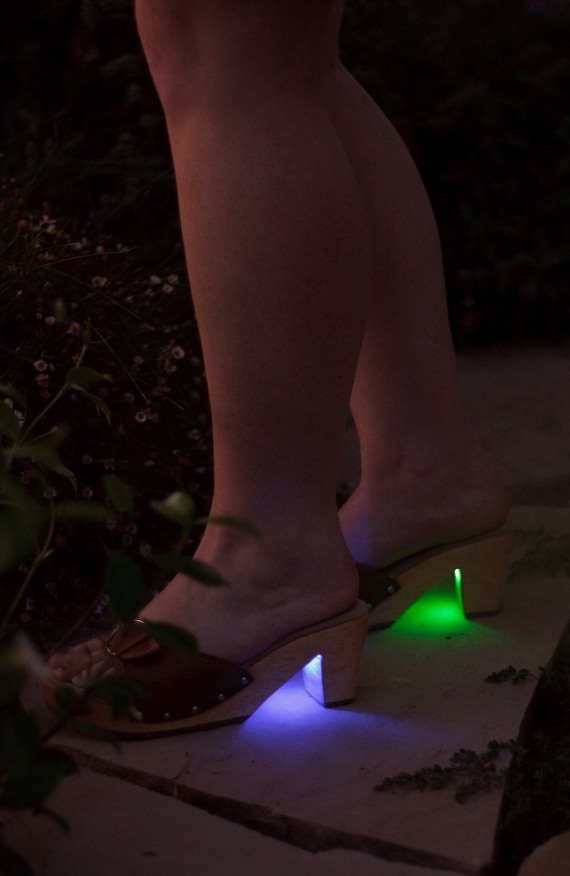
One thing there wasn’t, though, was women. I think I saw two other women the whole time I hung out there. I was kind of disappointed not to meet any other embedded systems people who share my gender, if only because they’d be the only ones who’d really appreciate my light-up shoes project.
So, this year, I looked in early October for the call for abstracts. It appeared, they were all set. Eeek! How could I have missed it again?!? Ahh, no, it just hadn’t opened yet. I emailed the track chair for my LED session (feeling guilty as I never wrote her that article I’d promised). That led to me talking to one of the organizers, actually getting to pitch a few ideas that aren’t open yet, maybe getting to co-chair a track. Whee!
The call for abstracts is open now. Go on, submit an idea or two. I’m most excited about the case studies for debug and test and the one about getting to “Hello World” in under five minutes. (Hey! That is what I did last year!)
And if anyone wants to join a panel, loosely on sensors, well, drop me a line. I’m percolating on my own ideas but happy to listen if someone wants to chat about theirs.
Here is a prototype for a light-up animal. Naw, this is a jelly fish from the Monterey Bay Aquarium. But if your idea for a talk is a quarter as cool as this jelly is, please submit it.
Oh! They love me! They really love me!
June 14, 2012 in Uncategorized | Tags: Making Embedded Systems, reviews, writing | Comments closed
One of my first reviews for Making Embedded System came on the O’Reilly site and it was a not a good review. I mean, it was a bad review (and it wasn’t particularly well written).
It was somewhat heartbreaking to have put all that work into a book and then have someone bash it. And he hadn’t really read it (one of the things he said was terrible was, funny enough, something I was saying was terrible if only he’d done more than flip through it).
Ouch. But I try (try really, really hard sometimes) to learn from mistakes and to be as mature as possible about such things. I totally agree with this author’s posting: “The biggest enemy of our careers is not bad reviews, but obscurity.” As with my view on ebook pirating, I may not like bad reviews but I do want my book to make ripples. I am not yet to Scalzi’s delighting in one star reviews but I’d almost (almost, maybe) have bad reviews than nothing. Of course, Scalzi’s examples are much funnier than mine. And he’s got a thicker skin from years of doing this.
But as we were gone on our cross country trip, two more reviews were added to my book on Amazon, heaping my collection of 5-star reviews there to a lucky 7. (Which isn’t to say that 8 or 9 or 53 would be unlucky, feel free to add more, I won’t mind.)
Now, I will admit that I know Ken Brown, one of the Amazon reviewers. And when he said, “Well, is there anything else I could do?” after tech reviewing it (and doing an awesome job with the review), I immediately asked if he could pretty please write a review.
Still, seven people like my book enough to take the time to write a review in Amazon. I’m sometimes surprised by what they liked most about it. I mean, check this out from James Langbridge, a guy I’ve never met (though we exchanged emails after he entered some errata):
This book is full of technical detail, but more importantly, it is full of wisdom. I had fun reading this, and to the question would I recommend this book to a friend? I already have, to junior members of my team.
I like “I had fun reading this”… such a wonderful thing to say about a technical book. And this:
I would say that the most valuable contribution this book makes is in explaining the design integration of hardware components and basic EE-technologies to a software developer who has not yet experienced the design of a sophisticated embedded system. – Ira Laefsky
And then on Goodreads, someone said exactly what I could have wished for:
I wish this book was around when I started working.
Because that is the book I wrote: the one I wish I had when I started.
Trip souvenir: Boston Public Library Card
May 7, 2012 in Uncategorized | Tags: awe, cross country, Making Embedded Systems, silly | 1 comment
If you had a book (a book that you wrote), where would you want to see it? I mean, other than the New York Times’ bestseller list.
A few weeks after it came out, my father-in-law found my book on a store shelf near Harvard. He took a photo of it, making me quite happy.
Still, it was disappointing that most bookstores don’t carry my book, it is only available for special order, which is silly. And, while tempting, I did not follow through on my idea to call all of the Barnes & Nobels, order a copy and, when it arrives, say nevermind so that it goes to their shelves for people to admire (and buy).
It was exciting to see my book, to actually touch it, especially for the first time. But that was a little anticlimactic because many of my friends got a copy before I did (from Amazon). O’Reilly gave me several author copies. I picked out one for myself and gave a couple to family (most of my supportive and generous friends bought their own copies). What to do with the other copies?
I love the library. It is a place where you can borrow books. As a child, it was an all-you-can-eat mental buffet, my family could never have afforded even a hundredth of the books I blew through as soon as I got my own card. It was a child’s card initially but I snuck into the big library (“waiting for my mom” got me in with the security guards). I’d go pick up my pile from the kid’s ara and then read the adult books (ok, the adult encyclopedia, the guards still kept track of me). I suspect my love of Wikipedia comes from these formative years.
Since I love the library, I donated copies to my two local library systems. They were humorously confused by the donation. See, I had to find the right person to donate it to, the acquisition librarian, so it wouldn’t go into the neverending fundraising used book sale.
The exchange for the Santa Clara system happened in person. The librarian was a little confused. Even as I was handing her the books, she wanted to make sure that I didn’t want to be paid for them. And then she explained that these would go into the system and be available to all the libraries, not the just the Campbell one. (Yes, of course!)
But one sad (ok, ecstatically happy) thing is that my book is always checked out. Of both libraries. And each library got extra copies beyond the two each I gave them. I have never managed to pop in and get a picture of my book with the library labeling (and the Dewey decimal stickers!). I do check, especially when I’m bummed for one reason or another… knowing people have checked out my book is spirit lifting.
I had hoped that we’d see my book in the Library of Congress in Washington DC. Despite common wisdom, they do not carry every book. One book that the Library of Congress does not have is (cue dirge music) my book. What is this nation coming to?
Actually, if I’d known and planned ahead, I might have tried to give a copy of my book to the LOC. That would have been spiffy but I didn’t bring any copies on the trip because I believed the myth (that LOC carried everything). The congress people would do well to understand the problems associated with creating robust embedded systems, it is an important subject for all our future.
Sigh.
However, when all seems lost, at its darkest, there are other opportunities. In this case, Boston Public Library. You may have seen their lions:
Boston public library carries my book! But not for checkout… How odd, I don’t know if it is better that it is a reference only book and they are afraid it will be stolen or worse that people don’t get to take it home to truly enjoy it. In order to check my book out from BPL, you have to fill out a form, get a library card to finish filling out the form, and then hand it to the nice lady who will go retrieve the books from behind a “Staff Only” door.
Once you have the book, start by admiring the Dewey decimal and BPL signage. There are many marble topped tables and other beautiful desks that lend gravity to the library.
Ok, once you’ve appreciated the awesomeness of my book in the library, in the Boston Public Library, now it is time to take the book on a wee adventure (remember: you can’t leave the library). You shouldn’t run through the library giggling and squeeing. It is frowned upon though if you run fast enough, no one will catch you so it is ok. Be sure to take pictures in well known locations though you may need a confederate. Just in case, be sure you can run faster than the confederate.
Yo ho ho and a bottle of rum
May 4, 2012 in Uncategorized | Tags: Making Embedded Systems | Comments closed
“I think your book must be doing well, it certainly is well pirated.”
When C said this about Making Embedded Systems, I suppose I was pleased. I mean, it is true that there are many e-copies of my book on the major (and minor) pirate sites. I find it kind of irritating that people can get my book without paying me or O’Reilly. But I doubt anyone gets my book for free without understanding that they are doing something wrong.
Most of the people who would buy my book write software for a living. If they don’t understand how copyright impacts them in the long term, then they aren’t smart enough to write software for long.
So most of the readers who pirate my book are either too dumb to realize it is wrong or too broke to care. These people wouldn’t have bought my book anyway. I don’t feel like I’ve lost out much because of them. And if they get something out of my book, if they manage to get some smarts. solve a problem or find a better way to create embedded systems, well, hey, that is ok. It is ok with me and it is ok with my publisher.
I think there may be a few more folks out there, the ones who want to try it out, to sample the book. I bet they get the book to sample, use it and keep meaning to pay but fail out of laziness. Those are the only group of pirates that truly annoy me.
I knew when I went with O’Reilly that electronic copies of my book with be available without DRM. That was a little scary. I spent a long time writing this book.
People who write technical books don’t do it for the money. We do it because we want to share what we know and ignite the passion of other people (or just make it easier for others than it was for us). Still, almost any one who writes a technical book (especially for O’Reilly) could have made more money doing the work instead of writing about it. For me, it certainly would have been easier. And I didn’t need it as resume filler, my resume is fine, thanks.
So I wrote the book to share. now I just need to share nicely. Today is the Free Software Foundation’s Day against DRM. To celebrate, O’Reilly is offering all of the DRM free ebooks (and that is all of them) for 50% off. But let them tell you:
In Celebration of *Day Against DRM* Save 50% on ALL Ebooks & Videos Having the ability to download files at your convenience, store them on all your devices, or share them with a friend or colleague as you would a print book, is liberating, and is how it should be. If you haven't tried a DRM-free ebook of video, we encourage you to do so now. And if you're already a fan, take advantage of our sale and add to your library. For one day only, you can save 50% on all O'Reilly, No Starch, and Rocky Nook ebooks and videos. Use code: DRMFREE Ebooks from oreilly.com are DRM-free. You get free lifetime access, multiple file formats, free updates. Deal expires May 4, 2012 at 11:59pm PT and cannot be combined with other offers.
Go buy my book. Go buy someone else’s. Have a ball! We really appreciate it when you buy our books. And we are happy to share our knowledge, experience and passion with you.


Recent Comments